
Alexandre Nuttinck
Sunday, May 3, 2026
The 20,000-Dollar Commit
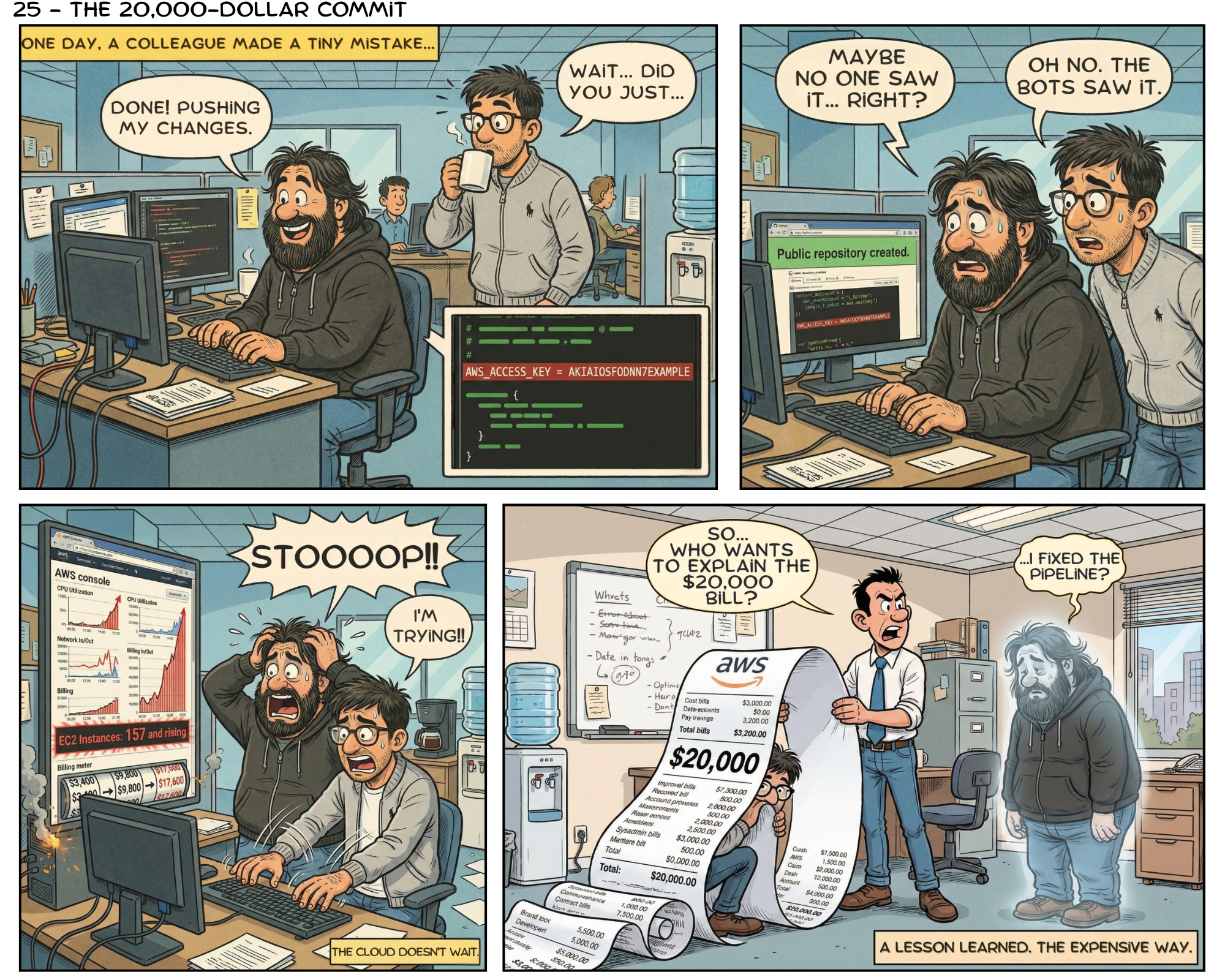
It started as a perfectly normal afternoon. A developer, happily working at their desk, pushed some code to a public repository. But that colleague made a tiny, seemingly harmless mistake. In the rush to get things done, he hardcoded an AWS access key and pushed it straight to a public repository.
“Maybe no one saw it… right?”
That is the desperate hope of every engineer who realizes what they’ve just done. But the internet never sleeps, and more importantly, the scraping bots never sleep. Within seconds of that repository going public, the keys were harvested.
The reaction was immediate. We watched in horror as the AWS console lit up like a Christmas tree. Hundreds of EC2 instances began spinning up at insane speeds to mine crypto. The resource graphs skyrocketed vertically, and the billing meter started spinning like a casino slot machine: $3,400… then $9,800… then $17,600.
We were frantically mashing keyboards trying to revoke the keys and kill the instances, screaming at the monitors to stop. But the cloud doesn’t wait, and infinite scalability goes both ways.
The next morning in the office was painfully quiet. The manager stood there holding an enormous AWS bill, asking who wanted to explain the $20,000 invoice.
From the corner of the room, a tiny, ghost-like voice replied:
“…I fixed the pipeline?”
It was a tough pill to swallow, but it’s a mistake you only ever make once. In the cloud, a mistake scales instantly.