
Alexandre Nuttinck
Monday, February 16, 2026
Bitnamipocalypse
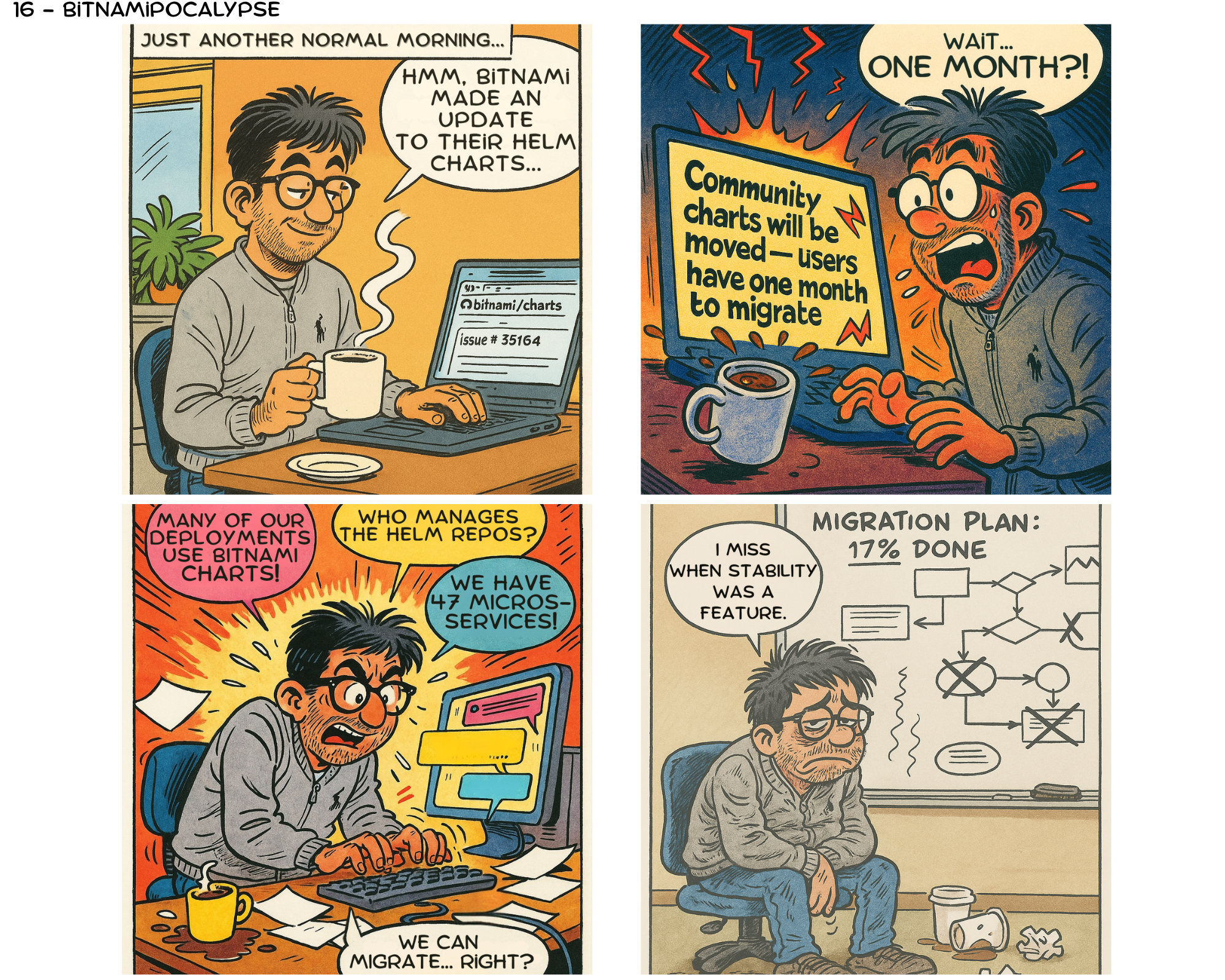
Do you remember where you were last summer when the notification popped up?
It started as a normal morning in DevOps. You were sipping your coffee, scrolling through GitHub issues, thinking the day would be about optimization or maybe finally tackling some tech debt. Then you saw it: bitnami/charts issue #35164.
The announcement was brief, but the implications were heavy: Community charts were moving. The migration window? One month…
I can still picture the collective panic in chat channels across industries. One moment, we were calm; the next, alarms were going off. “All our deployments use Bitnami charts,” someone typed. “We have 47 microservices!” another realized. It was the five stages of Helm chart grief compressed into a single afternoon.
But looking back now, the “Bitnamipocalypse” wasn’t an isolated incident. It was a warning shot. 😬
The Erosion of “Set and Forget” That summer rush to migrate feels like part of a larger pattern where “Stability” is no longer a default setting. It is becoming a premium feature.
- MinIO shifted gears to “source available,” pushing the open-source version effectively into maintenance mode.
- The NGINX Ingress Controller (the community version) is officially entering maintenance mode in March 2026.
The whiteboard in the office still has the faint scribbles of migration plans from last year, and yet we are already sketching out the next ones. The engineer who muttered, “I miss when stability was a feature,” wasn’t just complaining; they were identifying a shift in our ecosystem.
The New Reality In DevOps, we used to joke that change is the only constant. But lately, that constant seems determined to break things. As we look toward the NGINX sunset in 2026, the lesson from last summer is clear: We cannot treat external dependencies as static foundations anymore. We have to build with the expectation that the ground beneath us will move.